

A few months ago, Costa Rica's Caja Costarricense de Seguro Social (CCSS) announced that EDUS was starting to make resources available for interoperability. It's worth noting that the country still needs to make significant progress on the regulatory side, since today it's unclear how far the law actually lets us interoperate.
The CCSS announcement got us excited internally at Meddyg, since we've wanted these “green lights” for a while — ones that let us democratize the patient data that CCSS holds. That's where we started a proof of concept (PoC), building on this resource, and today we want to share how we built our own Patient Summary viewer based on what EDUS provides, with a bit of an extra boost and leaning on HL7 FHIR along the way.
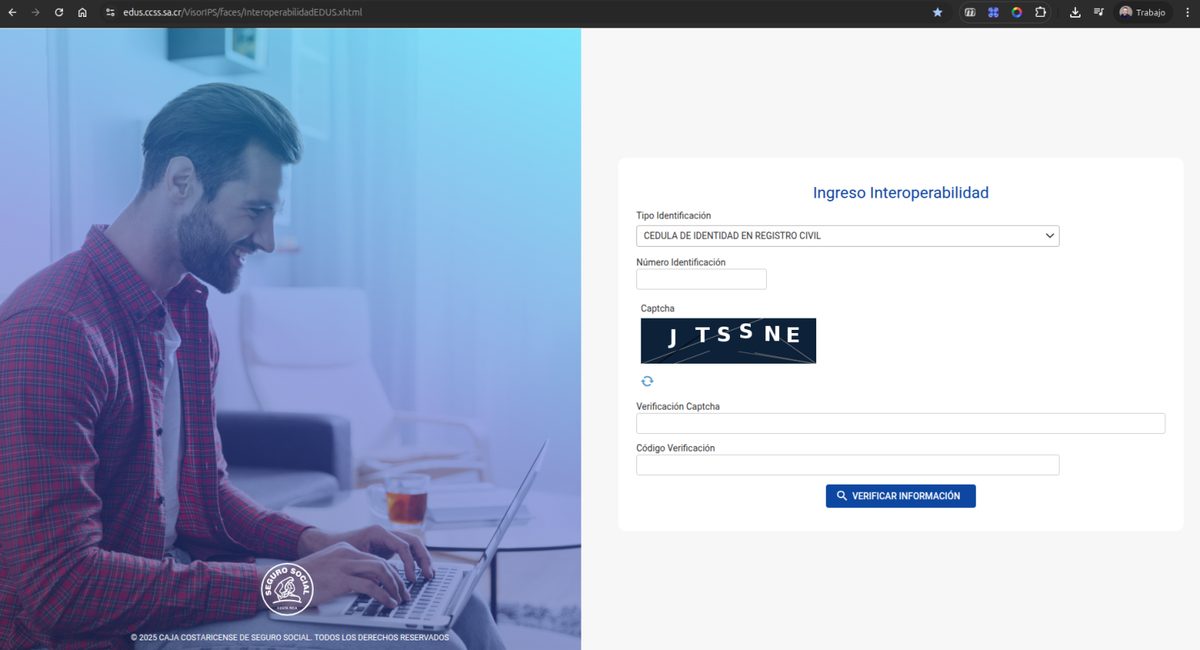
The EDUS viewer returns a FHIR resource — basically a Bundle resource — that CCSS is still refining in order to achieve cross-border interoperability as part of the Pan-American Digital Health Route project, driven by the Pan American Health Organization and the Inter-American Development Bank. This resource is also useful to us, since it's what EDUS currently provides for sharing with third parties with the patient's consent.
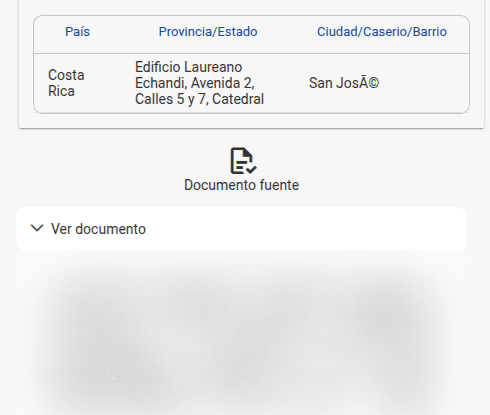
Based on this input, we set out to build an integration with EDUS that would do two things:
- Give patients a second option for viewing some of the relevant data available in EDUS.
- Offer the private sector, with the patient's consent, a way to access part of the information managed by EDUS.
This would let us explore how to use and complement the information available from EDUS, making better use of the data to generate additional value for the patient. It also opened up a new possibility: moving forward with a private HIE without overloading EDUS. That's how we managed to enable an alternative EDUS viewer.
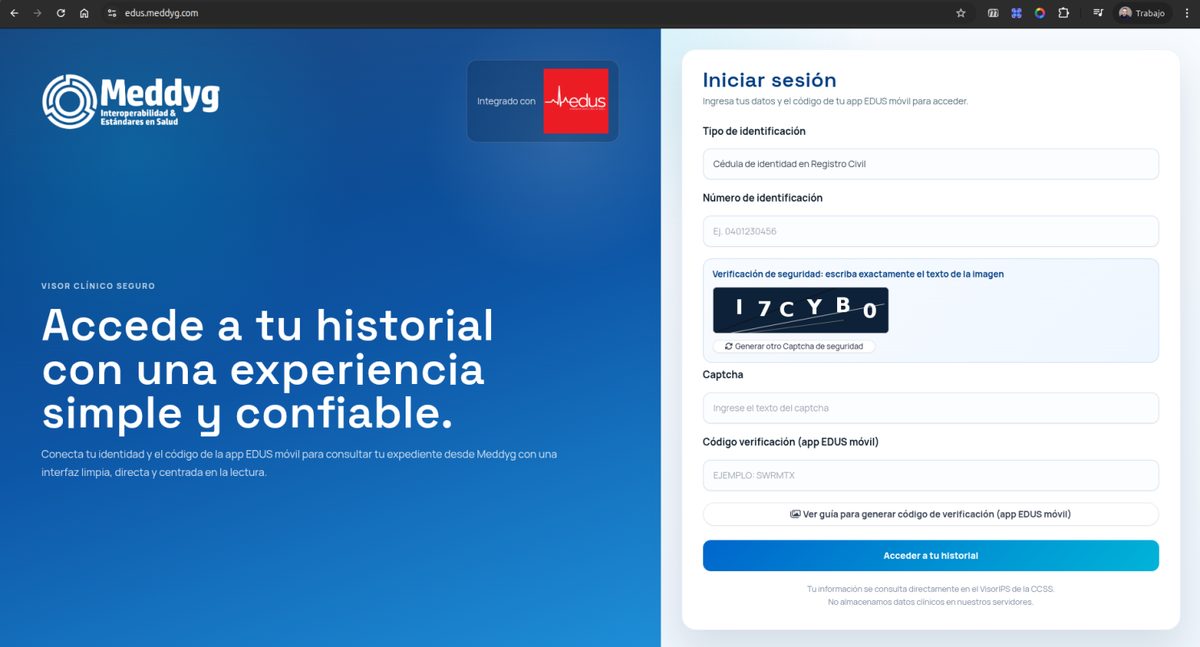
This let us reuse EDUS's own security measures, so to get the data we had to request the same information required by the official EDUS viewer. In other words, the data subject has to type in the captcha and the verification code generated by EDUS, which meant we didn't have to build additional mechanisms ourselves.
You can also watch this demo on its own page: EDUS Patient Summary Viewer demo.
We managed to define some interesting formats and extract data that, with better quality, could let us generate relevant alerts and notifications for both patients and physicians.
The opportunity in the EDUS Patient Summary viewer
It's worth noting that both the official viewer and the alternative Meddyg built can also be useful in international settings. Their use isn't limited to national territory, which means any physician treating a Costa Rican patient abroad can get clinical context.
Regulatory challenges
Even though our team considered setting up an IHE for this test, we reviewed Costa Rica's Law on the Protection of Individuals with Regard to the Processing of Their Personal Data (Law 8968). While it does let data subjects grant or revoke consent over the use of their information, on its own it doesn't provide the necessary scope. Applying it would require complementing it with legal or administrative mandates, agreements and access-control mechanisms.
Room for improvement
The information available in these viewers is based on the profiles from the HL7 FHIR International Patient Summary implementation guide, which in turn is based on the ISO 27269:2025 specification. Costa Rica still has the challenge of enabling its own national IPS implementation guide — a goal CCSS is working toward so that we can all achieve interoperability.
The IPS from EDUS, as well as the one Meddyg consumes for its own viewer and integrations, could include more complete data, giving organizations outside CCSS better context on a patient's health history. For now, it's not a bad start, since the hardest step has already been taken: having some dataset for the population at all.
The data EDUS offers gives visibility into immunization schedules, patient-identified allergies — no small thing — non-standardized medication history, and patient diagnoses and conditions based on the World Health Organization's terminology catalog, ICD-10.
This year, Costa Rica's Ministry of Health has been coordinating how to make SNOMED International's clinical terminology available nationally, which would be a huge leap forward for data quality around diagnoses, procedures, medications and more.
Meddyg: next steps
From where we stand, we'll keep strengthening the viewer we've built. We also want to show that it's possible to build integrations aligned with the standards required for interoperability, and that one of the biggest challenges we have as a country is starting to take concrete steps to move data from source systems into normalization and standardization processes.
As part of this work, we'll carry out a terminology and data-modeling review to scope the effort needed to bring some of the data EDUS offers today into the profiles of the national FHIR Core Implementation Guide (still under development) and the cross-border IPS Implementation Guide (LACASS) from RACSEL — the Latin American and Caribbean Digital Health Network — so we can have truly interoperable resources within the national ecosystem.
You can access the Meddyg viewer at https://edus.meddyg.com
Note: the patient's personal data shown in the video is not real; part of the information corresponds to the first woman to hold the office of First Lady of Costa Rica, Pacífica Fernández Oreamuno.