

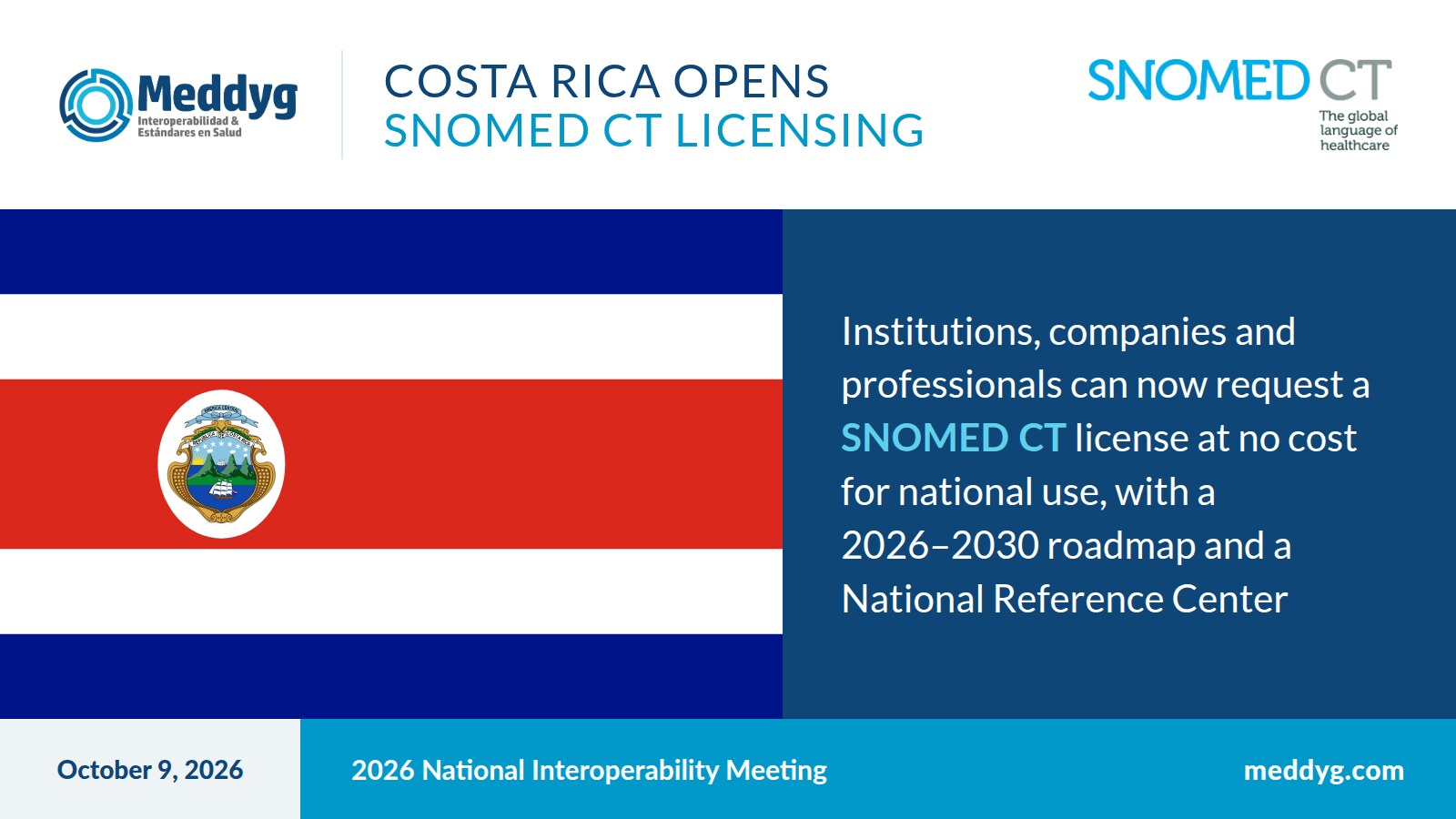
Costa Rica now has an official channel to request a SNOMED CT license. Vice Minister of Health Allan Mora and Iván Rojas, Digital Health advisor to the Minister of Health, made the announcement on Friday, October 9, at the close of the 2026 National Interoperability Meeting.
The announcement came two days after the signing of the Health Interoperability Decree and fills a missing piece. The decree defines how health data must be exchanged; SNOMED CT provides the common clinical language so that the data means the same thing in every system that receives it.
Alongside the announcement, the Ministry of Health published the SNOMED CT Costa Rica site (in Spanish). It presents the 2026–2030 national roadmap, the affiliation procedure and the progress of the National Reference Center (Centro Nacional de Referencia), the country's point of contact for everything related to the terminology.
What SNOMED CT is and why it matters
SNOMED CT is the most comprehensive clinical terminology in the world: hundreds of thousands of concepts — diagnoses, findings, procedures, organisms, substances — each with a unique identifier and logical relationships to the others. Its value lies in the fact that the same concept is recognized identically at the hospital, the private clinic and the laboratory, even if each one writes it in different words.
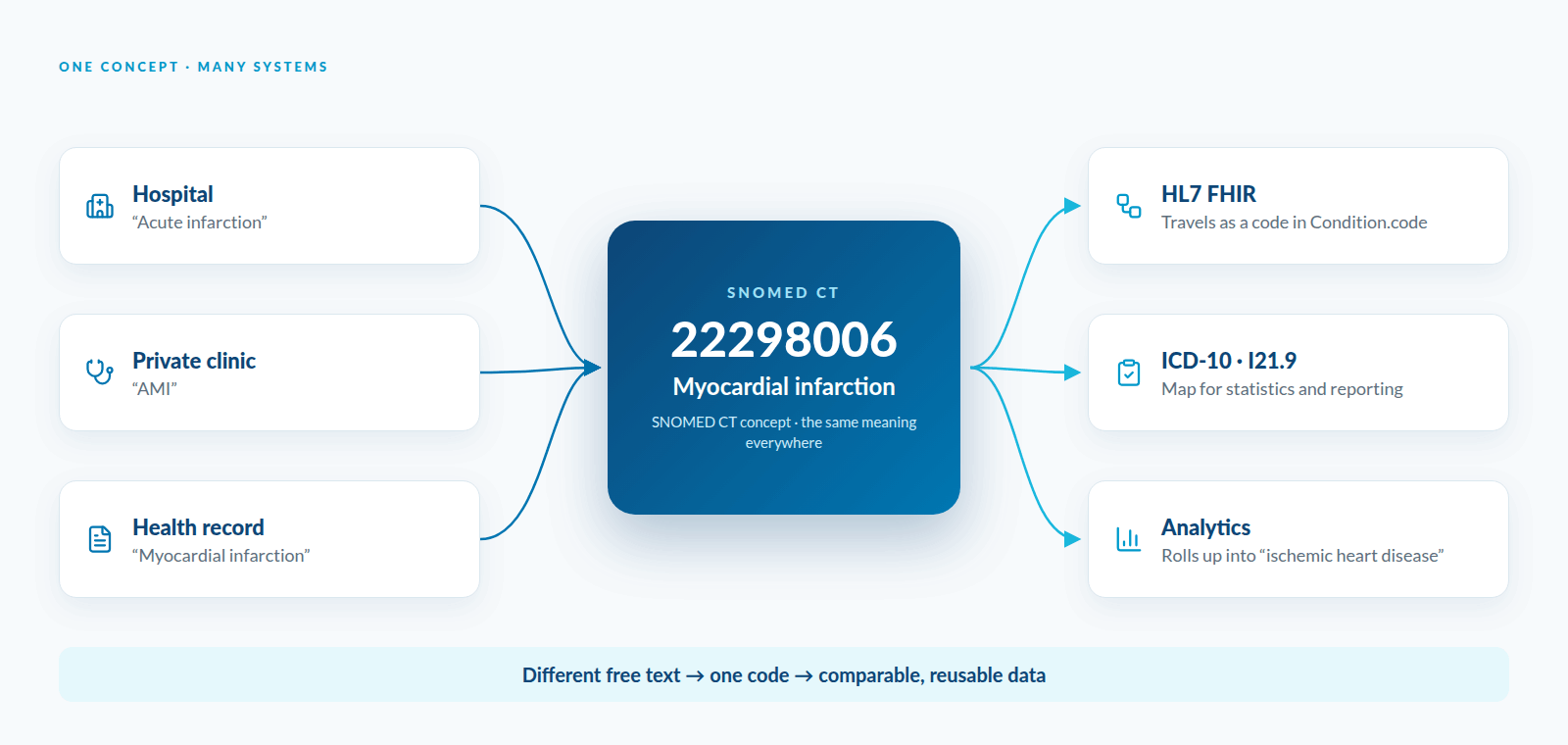
As the Ministry itself puts it, HL7 FHIR carries structured information and terminologies let everyone interpret what that information means. Without that semantic layer, interoperability moves data but does not always move meaning.
Costa Rica, a SNOMED International Member Country
Costa Rica formalized its membership in SNOMED International, the not-for-profit organization that maintains the terminology, in 2026, and it was announced on July 28. The Ministry of Health took on the role of National Release Centre, responsible for the governance and distribution of SNOMED CT in the country, as part of the 2023–2030 National Digital Health Strategy.
Being a Member Country has an immediate practical consequence: using the SNOMED CT International Edition within Costa Rica carries no individual fee. Hospitals, clinics, laboratories, software developers, universities and professionals can license it at no cost for national use. Use in non-member countries, extensions and special agreements may have different conditions.
How to request the license
Requests are made on SNOMED International's official platform, the Member Licensing and Distribution Service (MLDS), starting from the Costa Rica country portal. The National Reference Center reviews each request and supports new affiliates during their first 30 days.
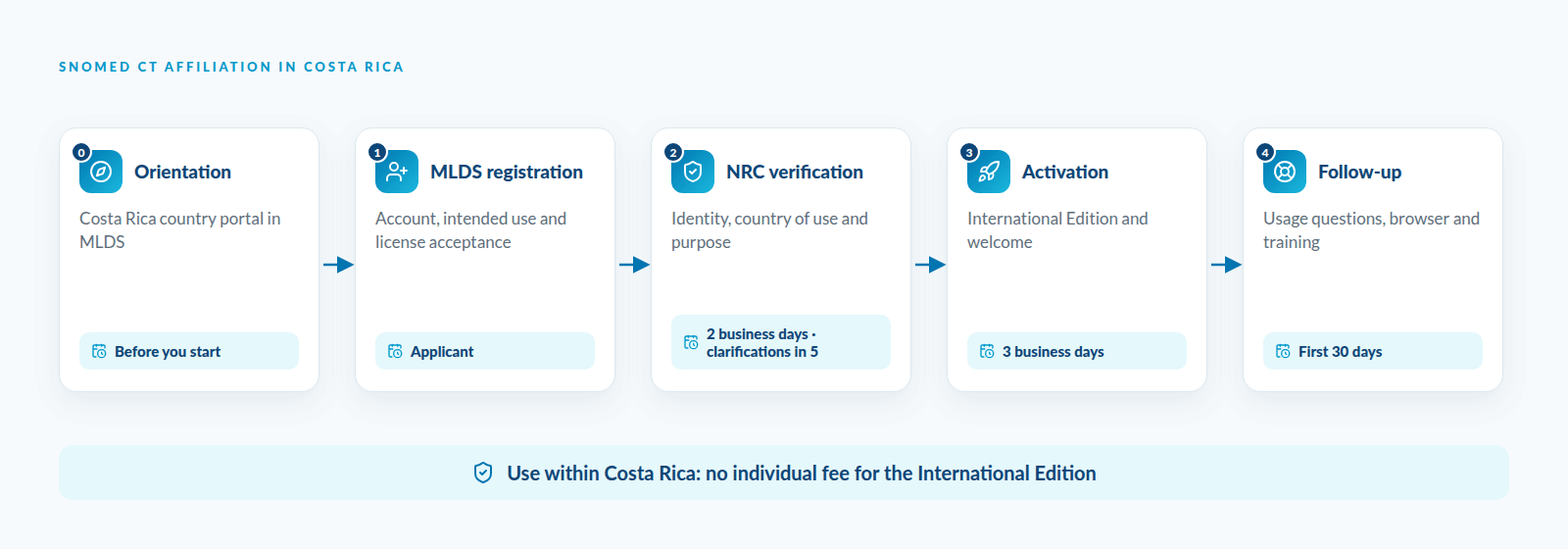
Before you start, have the following at hand:
- A valid email address with inbox access, to activate the account.
- Identification of the applicant person or institution.
- A description of the intended use of SNOMED CT.
- The countries where it will be used.
- Information about the systems and institutions where it will be deployed, if applicable.
Licenses are per person: several people from the same institution can affiliate, and sharing an institution does not make their requests duplicates. The Ministry states that the National Reference Center will review each case in an "inclusive, proportional" way and "with a clear answer".
The 2026–2030 roadmap
The Ministry organizes adoption around four axes: adoption planning, standards and artifacts, enabling infrastructure and capacity building. Planned activities include a shared terminology server and the National Release Centre (2026–2027), contextual Spanish translation and mappings to other classifications (2026–2029), a national SNOMED CT extension (2027–2030) and a national education and training program spanning the whole period.
The first use cases, proposed for 2026–2028, are concrete:
| Use case | What is coded with SNOMED CT |
|---|---|
| National Tumor Registry | Oncology diagnoses, findings, procedures and epidemiological variables |
| Vaccination systems | Immunizations, medications and related events |
| Medical imaging | Radiology findings, integrated with HL7 FHIR and DICOM |
| Clinical laboratories | Results, observations and conditions, as a complement to LOINC |
| Pathology and anatomic pathology | Macroscopic and microscopic findings, diagnoses and procedures |
| ICD-10 / ICD-11 maps | Official equivalences for statistics, epidemiology and international reporting |
Emergency care, primary care, the clinical record, national registries, information exchange and research will follow. The ecosystem includes the Ministry of Health, the CCSS (Costa Rican Social Security Fund), INS, INCIENSA, MICITT, the private sector and academia.
How Meddyg supports SNOMED CT adoption
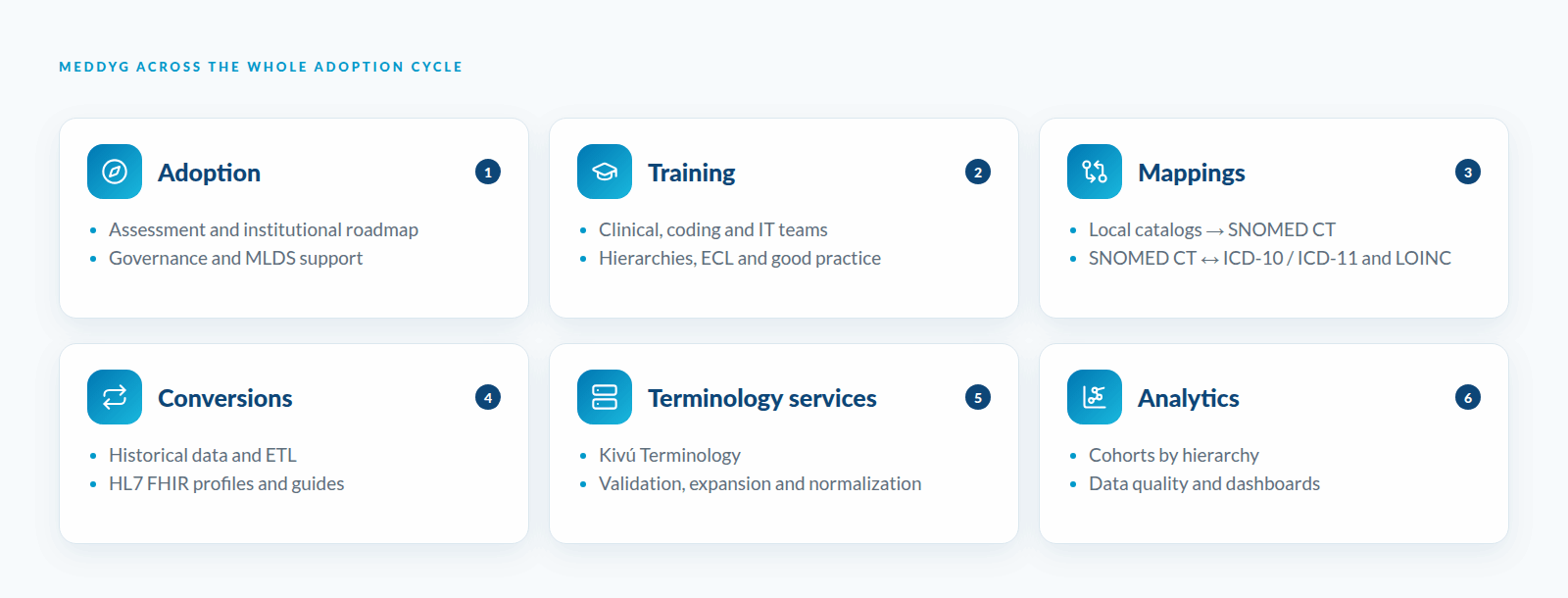
Getting the license is the first step. What follows — getting systems to record, exchange and analyze data coded with SNOMED CT — is clinical engineering work, and it is the work we do at Meddyg.
Adoption
We assess which terminologies and catalogs your organization uses today, where meaning gets lost and which use cases to tackle first. From there we build an institutional roadmap aligned with the national one, define the governance of terminology content and support you through MLDS affiliation.
Training
We train each team in what it needs. Clinical and coding staff learn how to search for and choose the right concept. IT teams learn the SNOMED CT logical model, its hierarchies, the Expression Constraint Language (ECL) and integration with HL7 FHIR. Analysts learn how to query coded data.
Mappings
We bring your local catalogs — diagnoses, procedures, lab tests, findings — to SNOMED CT concepts, with clinical review and quality control. We build and maintain the equivalences with ICD-10, ICD-11 and LOINC, and publish them as HL7 FHIR ConceptMaps so any system can consume them.
Conversions
We migrate historical data so that what was recorded before adoption stays useful, with traceable ETL processes. We also define the profiles and HL7 FHIR implementation guides that state which SNOMED CT value sets apply to each element, and adapt your data model to receive them.
Terminology services
With Kivú Terminology we make a shared terminology service available to your systems: concept lookup, code validation, value set expansion and semantic normalization, so every application codes against the same criteria and the same version, with no local copies of the catalogs.
Applying it to each use case
| Use case | How it works in practice |
|---|---|
| Tumor registry | Morphology and site subsets defined with ECL, and mapping to ICD-10 for statistical reporting |
| Vaccination | Immunization procedures and adverse events coded consistently across all vaccination points |
| Medical imaging | Structured findings in the radiology report, from Kivú RIS to the FHIR exchange |
| Laboratory | LOINC identifies the test; SNOMED CT codes the qualitative result, the organism and the specimen |
| Pathology | Structured protocols with coded diagnoses and findings, ready for the tumor registry |
| ICD-10 / ICD-11 | Clinical capture in SNOMED CT and classification derived by map, with no double entry |
Analytics with SNOMED CT
Coding with SNOMED CT changes what you can ask of your data. Because each concept knows its "parents", a single query finds every patient with any form of ischemic heart disease, without listing hundreds of codes. We help your organization to:
- Build cohorts and dashboards from the hierarchies and from ECL queries.
- Measure data quality: share of coded records, and codes that are inactive or outside the expected value set.
- Prepare data for analytical and research models, such as OMOP, that use SNOMED CT as their standard vocabulary.
- Combine the clinical view (SNOMED CT) with the statistical view (ICD-10 / ICD-11) from the same record.
Let's get started
Costa Rica now has the license, the roadmap and the institution coordinating adoption. Organizations that start now will be ahead for the first use cases and for the exchange the decree requires.
If you want to know where to begin, how much of your information can already be brought to SNOMED CT or how to put it to work in analytics, let's talk.
References
- SNOMED CT Costa Rica: roadmap and affiliation, Ministry of Health (in Spanish).
- Costa Rica portal in MLDS, SNOMED International.
- Costa Rica Joins SNOMED International, SNOMED International, July 28, 2026.
- SNOMED CT licensing, SNOMED International.